Waves in a string
Complément : A video (in french) about waves in a string (with some fun science experiments)
("Unisciel" and "Culture Sciences Physiques")
Fondamental : Transverse vibrations of a string ; d'Alembert's wave equation
Consider an inextensible rope, linear density
 , stretched horizontally with a constant force
 .
.
At equilibrium, the cord is horizontal.
It is assumed in the following that gravity is not involved (if not, the shape of the rope is a chain).
We will study the small movements in the vicinity of this equilibrium, with the following model :
The element of rope located at coordinates
 at equilibrium is at coordinates
 at non equilibrium. Alternately, we can say we neglect its displacement along (Ox).
 The angle
 created by the tangent to the rope at the point of abscissa
 at time
 is infinitely small (
 ,
,
 and
and
 , see figure).
If we consider a fictitious cut at the point abscissa
, the action of the left side of the rope on the right is reduced to a tangential force to the rope noted
 .
.Similarly, the action of the right on the left side reduces to a force
 .
. According to the principle of reciprocal actions,
 .
.
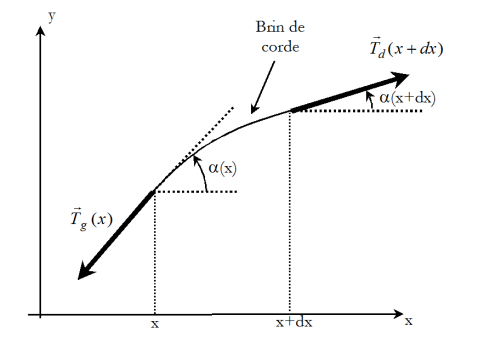
The Newton's second law applied to a rope element located between the abscissas
and
 gives :

In projection, and noting
 :
:

If we limit ourselves to the order
 , equation
 provides :

Equation
 can be rewritten :

Yet :

Where :

We find again the d'Alembert's wave equation.
In the case of the rope, the wave is called transverse (displacement occurs along
 axis).
Attention : Wave equation d'Alembert

We find a d'Alembert's wave equation.
The wave propagation speed is :

The tighter the rope and the lighter the rope weight are, the greater the speed is.
Fondamental : The string Melde
In the experience of Melde, the extremity abscissas
 of a rope is fixed (
 ) and operator imposes at
 a harmonic movement :

The angular frequency is
 .
.
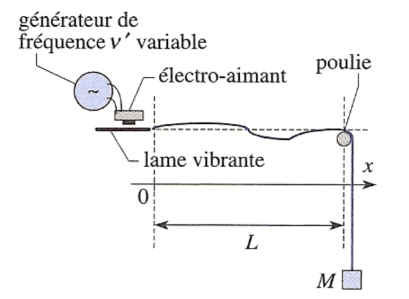
We are interested in forced regime (driven vibration), obtained after disappearance of the transitional regime.
It is thus sought a solution of the d'Alembert equation corresponding to a standing wave of as the same angular frequency as of that of the exciter :

The boundary conditions needed :

And :

Whence :

Is :

Therefore :

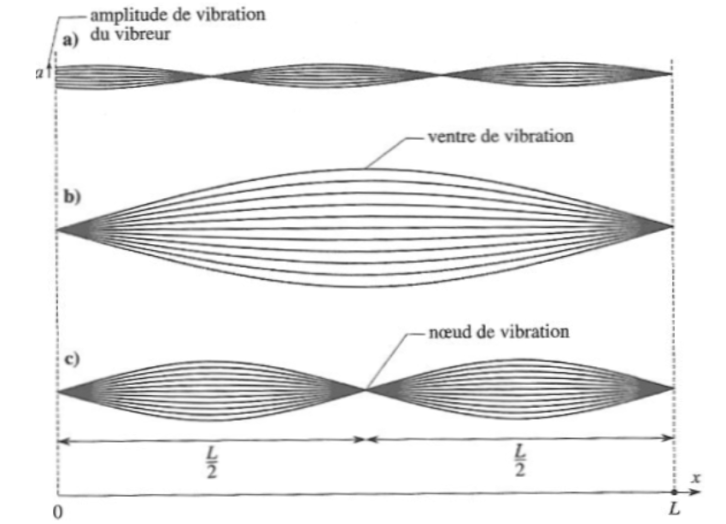
The amplitude is maximum for :

And is, in absolute value :
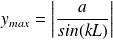
This maximum amplitude becomes infinite (the rope is then in resonance) to excitatory pulses such as :

corresponding to the eigen-modes of the string.
However, the inevitable damping and stiffness of the rope make the maximum amplitude keeps a finite value.
Thus stationary wave becomes resonant (in driving regime) when the driving angular frequency coincides with a vibrational frequency (open plan) of string vibration, just like a LC series circuit where
 the angular frequency of vibration refers to the own frequency of free regime (free oscillation) and the angular frequency of resonance in forced regime (forced oscillation).
Complément : A video on Melde's rope
Complément : A video (in English) on mechanical waves
Complément : A lecture video on waves in a rope (Reference "college Physics")
Simulation : JAVA animations by Jean-Jacques Rousseau (University of Le Mans)
Simulation : Animation JAVA (University of Colorado Boulder)
Wave on a String :