Maxwell's equations
Fondamental :
In Maxwell's theory, the interaction between two particles is transmitted through local variations of the electromagnetic field.
This propagation of the interaction through the electromagnetic field is possible via electromagnetic waves, which have a celerity
 .
.
To picture the interaction between two particles in the setting of a field theory, there is an image :
Two bottle caps A and B are floating on the water. They are initially steady.
A vertical oscillation of A creates oscillations of the water. The latter are transmitted locally in all directions until they reach the point B. Then point B is set in motion.
Maxwell's equations are true locally.
They express the relationship between the electromagnetic field and its sources :
 (Gauss' law for electricity)
 (Gauss' law for magnetism)
 (Faraday's law of induction)
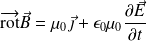 (Ampere's law)
Maxwell's equations and charge conservation :
Maxwell's equations hold the principle of charge conservation.
Indeed, if we apply the divergence to the equation about Ampere's law :

Thus :

Because it is a consequence of Maxwell's equations, it is not necessary to add charge conservation to the statements of electromagnetic.
Need for displacement current
 :
:
For any kind of state, let's write :

Then :

Indeed : (see the lesson "Vector calculus")

Moreover, the charge conservation principle induces :
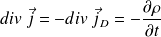
Gauss' law gives :

Thus :
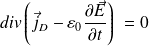
The most simple solution to this equation corresponds to the choice of a displacement current :
Attention : Maxwell's equations
-
(Gauss' law for electricity)
-
(Gauss' law for magnetism)
-
(Faraday's law of induction)
-
(Ampere's law)