
Malus' theorem, superposition of a plane wave and of a spherical wave
Take 20 minutes to prepare this exercise.
Then, if you lack ideas to begin, look at the given clue and start searching for the solution.
A detailed solution is then proposed to you.
If you have more questions, feel free to ask them on the forum.
A converging lens is used
 , pierced at its center, as two-wave interference system.
A point source
 , monochromatic wavelength
 , is placed at the focal object
 of the lens.
It follows that the wave emerging from the lens is plane and that directly transmitted through the hole is spherical.
The hole has a diameter
 on the output face
and a depth
on the output face
and a depth
 along the axis.
Question
Give the analytical expressions of waves that overlap ; be adopted as the origin of phase waves in
and it is assumed that these two waves have the same amplitude.
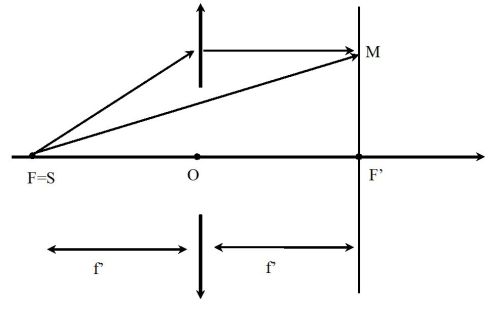
The source is the focus of the lens : it emits a spherical wave.
The lens transforms into plane wave.
The optical path
 to go from
to
to go from
to
 through the lens is equal to that to go from
to
through the lens is equal to that to go from
to
 (use the theorem of Malus) through
 . Therefore :

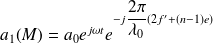
Expression of the plane wave in
is :
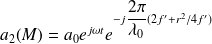
For the spherical wave that goes directly from
to
, the optical path is (with
 ) :
) :

The amplitude of the spherical wave is :
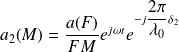
Whether, assuming that this wave has the same amplitude as the plane wave :
The resulting amplitude in
is :

Question
What is the intensity in the plane
 located at the same distance
 of the output face of
as
of the output face of
as
 , as a function of the cylindrical coordinate
 ?
?
Deduce the nature of the interference fringes.
The light intensity is :

The fringes are here rings (corresponding to
 ) centered on
. A bright ray is given by :
) centered on
. A bright ray is given by :
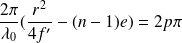 (with
(with
 an integer)
So :

Question
Calculate the radius extreme bright fringes knowing that :
 ;
;
 ;
;
 (index of the glass of
)
(index of the glass of
)
The point
is in the interference field if
 .
.
is calculated by taking
 then taking
 .
.
We find
 and
and
 .
.
In the latter case, take
 and recalculate
. We find
and recalculate
. We find
 .
.


