Fourier analysis and electronic
Fondamental : Fourier series decomposition
A periodic signal
 of period
 may (under certain conditions that are supposed to be checked physically) be decomposed into a sum of sine functions (Fourier series decomposition) :

The coefficients
 ,
,
 and
and
 are constant and given by the integrals :

We note that the coefficient
is the average value of
.
The term corresponding to
 (an angular frequency equal to that of the signal
) :
(an angular frequency equal to that of the signal
) :

is called the fundamental.
The general term :

is harmonic of rang
 .
.
Even signal
and odd signal :
If
is odd (
 :
: The development in Fourier series of the signal
then includes only sine terms (coefficients
are zero) : 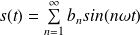
If
is even (
 :
: The development in Fourier series of the signal
then includes only cosine terms (coefficients
are zero) : 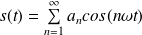
Frequency spectrum :
The general term
may be in the form :

If we denote :

So :

And the periodic signal
becomes :

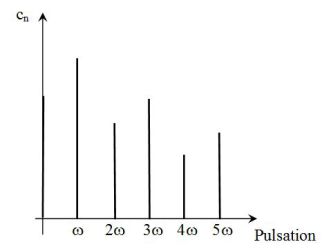
The frequency spectrum (or spectral representation) of the signal
is obtained by taking the ordinate the amplitude of the harmonics (that is to say the coefficients
,
or
 ) and in the abscissa the corresponding pulses.
Exemple : Some special signals
Square wave :
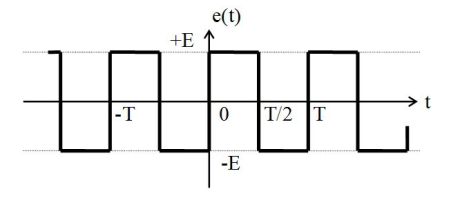
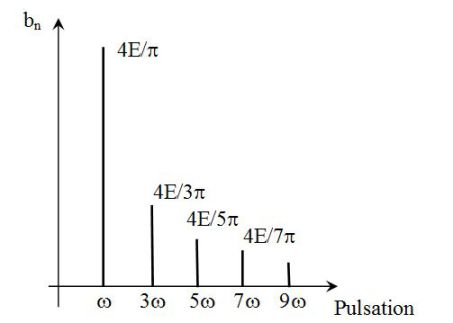
The niche voltage (or square voltage)
 in the following figure can be decomposed into Fourier series as :
This is an odd function. Therefore, the development in Fourier series does not comprise cosine terms.
Note that the harmonics are odd rang (of form
 ) and that the coefficients
decrease as
) and that the coefficients
decrease as
 .
.
The following figure shows the frequency spectrum of the square signal.
Triangular signal :
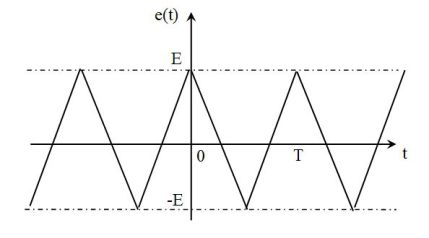
The triangular voltage
of the figure can be written :
This is an even function. Therefore, the development in Fourier series does not include the sine terms.
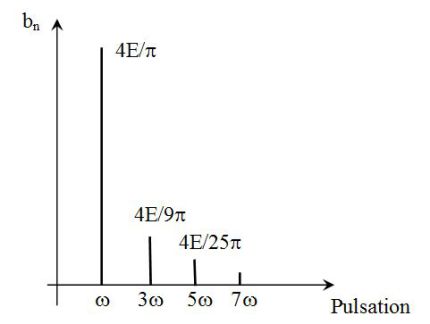
Note that the harmonics are odd (of form
) and that the coefficients
decrease as
 .
.
The following figure shows the frequency spectrum of the square signal.
Java animations (By JJ Rousseau, University of Le Mans) :
Complément : Average value, effective (RMS) value, Parseval formula and form factor of a signal
is a periodic signal, the Fourier series decomposition is :

The average value of
is :

The RMS value is :

Using the decomposition into Fourier series :

Knowing that the average value of a sine function is zero, the average value of a product of two sinusoidal functions of different pulses is zero and that the average value of the sine square is
 , we get :
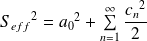
This is the formula Parseval : "The square of the effective (RMS) value of a periodic signal is equal to the sum of the square of its mean value and squares of the RMS values of the harmonics".
Two special cases :
If
is a pure sine wave : 
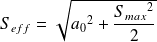
If a sinusoidal signal
is shifted by a DC component
:
The form factor (noted
 ) of a periodic signal
is the ratio of the RMS value and average value of the signal :
) of a periodic signal
is the ratio of the RMS value and average value of the signal :
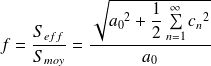
For continuous signal :
 .
. -
is not defined for a periodic signal of zero mean value.
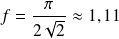
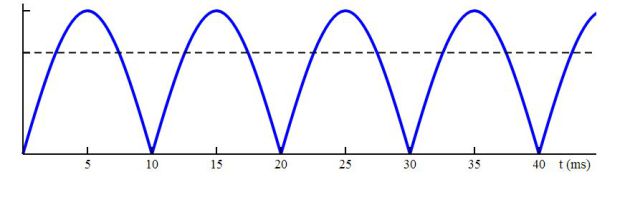
For a sinusoidal-wave rectified signal :
Complément : Harmonic Distortion
Consider a nonlinear electrical system when the input voltage is sinusoidal, the output voltage is not or has a different pulse to that of the input.
Is then carried out a harmonic decomposition of the output signal (assuming that it is periodic) :

If the system was strictly linear, only
 degree coefficients are nonzero.
Terms of order greater than or equal to
 are the harmonic distortion.
Called harmonic distortion rate, noted
 and expressed in dB, the ratio between the power of the harmonic terms and that of the total signal :
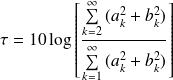
For a linear system,
tends to
 .
.
Example :
The output is connected to the input by the relationship :

With :

The sinusoidal input is assumed :

The output is :

With :

It comes :

Assuming
 , we obtain :

Harmonic distortion rate is :

Harmonic analysis (using a spectrum analyzer, for example) would bring out these nonlinearities.
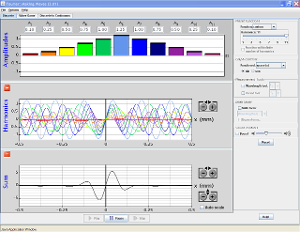
Simulation : An animation on the Fourier series decomposition (University of Colorado)
Learn how to make waves of all different shapes by adding sine or cosine.
Make waves in space and time and measure their wavelengths and periods.
See how changing the amplitudes of different harmonics changes the waves.
Compare different mathematical expressions for your waves.
| Cliquer pour lancer |