
Optical path and Malus' theorem
Fondamental : Principle of inverse return of light
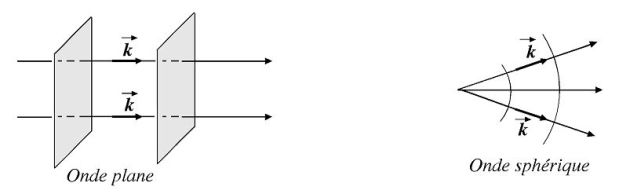
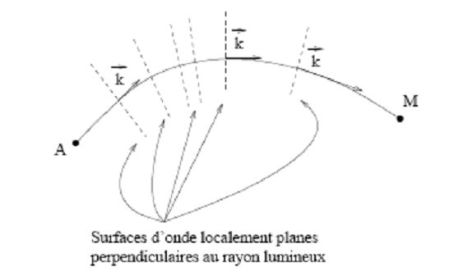
Light rays of geometrical optics are tangent, at any point, to the direction of propagation of the light wave.
The light rays are parallel to the wave vector
 . These are the paths of energy.
Principle of reversibility of light :
"The laws of reflection and refraction are independent of the direction of travel of light".
If we reverse the direction of light propagation, the light rays are unchanged.
Fondamental : Phase of a light wave
For a monochromatic light (within the scalar theory of light) :

The period
 , the frequency
 , the pulse
 and the wave vector
whose modulus is :
and the wave vector
whose modulus is :

Where
 is the wavelength in vacuum.
The frequency of a visible electromagnetic wave determines its color, again characterized by its wavelength, provided the propagation medium is specified.
The link between the temporal and spatial variations is given by the speed of propagation and depends on medium.
In a vacuum :

In a material medium where the wave propagates at the speed
 : (
: (
 is the index of the medium assumed to be homogeneous)
Phase difference between two points on the same ray of light :
In a homogeneous medium of index
, a rectilinear light ray is determined by an arbitrary point
 and its unit vector
 .
.
 is any point of this radius,
 is the length traveled by the light between
 O and
, counted positively in the direction of propagation.
O and
, counted positively in the direction of propagation.
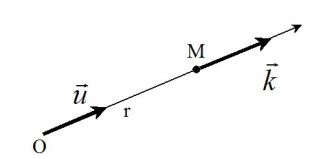
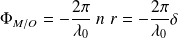
The phase of the wave in
can be written :

Thus, the phase difference between the points
and
is (actually, the relative phase of the wave in
compared to
) :

Here one sees the interest of the concept of optical path,
 and :
and :
Attention : Optical path concept
Is a medium defined at any point
 by an index
 ; we define the optical path
 between two points
 and
and
 , along a curve
 by :
by :

The optical path is equal to the distance that would cross the light in vacuum during the same time
 it takes to cover the curve
in the considered medium. Indeed :
it takes to cover the curve
in the considered medium. Indeed :

The optical path is equal to
 times the time taken for light to get from
to
in the medium of index
.
times the time taken for light to get from
to
in the medium of index
.
Moreover,
 and, for a homogeneous medium,
 ,
,
 is the distance between points
and
.
is the distance between points
and
.
And the phase of the wave in
can be written :

Fondamental : Malus' theorem
"In an isotropic medium, after any number of reflections and refractions, rays from the same point source remain perpendicular to the wave surfaces".
For a plane wave, the rays are parallel to each other and perpendicular to the planes of waves.
For a spherical wave, the light rays are precisely the wave spheres rays.
This theorem will be admitted and justified by some examples.
We consider the case of the following figure :
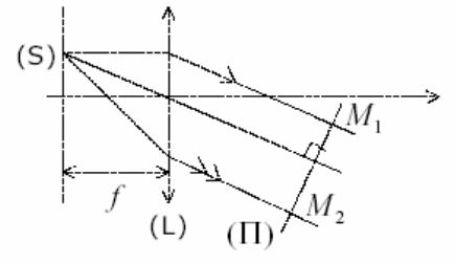
The light source
 is placed in the object focal plane of a lens
 .
.
The rays emerge parallel ;
 is a wave plane and the optical paths
 and
and
 are equal :

Fondamental : Stigmatism
Two points
and
will be stigmatic with respect to an optical system
if the optical path
 is independent of the beam passed through the system.
An object point
and image
by an optical system consisting of mirrors and lenses.
Considering any two light rays connecting
to
and intersect
 and
and
 with a wave surface
 .
.
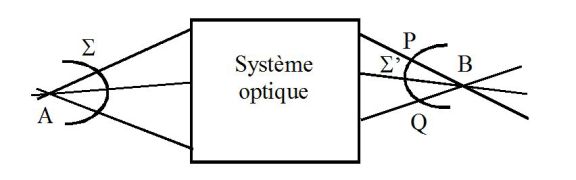
According to the theorem of Malus :

According to the principle of reversibility of light,
 and
and
 are light rays and :

Is :

Therefore :

The optical path between two points combined with a stigmatic optical system is independent of the radius between them.
It may also indicate that the propagation time of the rays emitted simultaneously from point
to
does not depend on the rays, since there is stigmatism.
Therefore, the optical paths
 and
and
 are equal.


